

Many B2B marketing and sales teams are on autopilot. I offer this series as observations and a belief that we can do better.
Many B2B marketing and sales teams are operating on autopilot.
That may sound harsh but consider the evidence. We have more access to customer feedback, market research, buyer behavior data, surveys, analytics, and industry insights than at any point in business history. Buyers constantly tell us what they want, what they value, what frustrates them, and how they make decisions.
Yet many organizations continue operating as if little has changed.
That disconnect is the topic of this series.
The Listening Gap
At its core, We’re Not Listening is a series of articles about the gap between what markets and customers are telling us, and how B2B organizations respond.
The problem is rarely a lack of information. Most companies already know that buyers are overwhelmed, skeptical, short on time, and increasingly resistant to marketing friction. They know trust is harder to earn. They know buying decisions involve more stakeholders, more scrutiny, and more risk than they once did.
The evidence is not hidden. The challenge has adaptation.
Knowing something has changed is not the same as changing because of it.
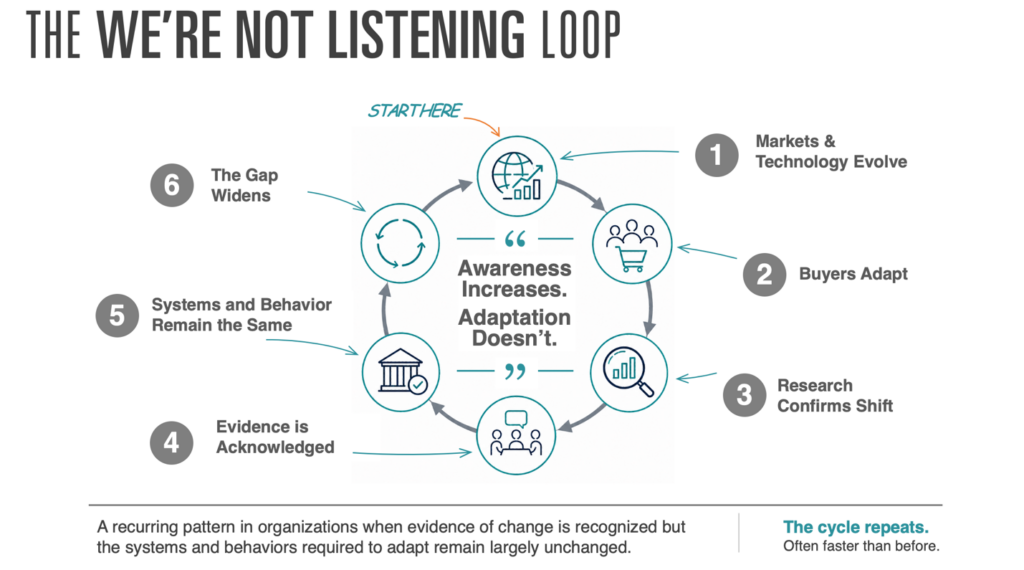
Over the years, I’ve noticed a pattern that appears across industries, business models, and company sizes. I call it the We’re Not Listening Loop:
- Markets & technology evolve.
- Buyers adapt.
- Research confirms the shift.
- Organizations acknowledge the evidence and invest in technology.
- Business go-to-market systems remain largely unchanged.
The cycle repeats.
New technologies emerge. New channels appear. New buyer expectations develop. Companies discuss the implications, attend conferences, publish reports, and commission research. Then many return to familiar habits, metrics, and assumptions.
The result is activity without meaningful adaptation.
Why It Happens
This is not a criticism of marketers, sales teams, or business leaders.
Most people are doing exactly what they were taught to do. They operate within systems, incentives, processes, and performance measures that were often designed for a different era.
Organizations frequently respond to disruption by adding new tools to old assumptions.
Digital transformation provided countless examples. Companies invested heavily in technology but often struggled to rethink the processes and behaviors surrounding it. Today, artificial intelligence presents many of the same challenges. The conversation quickly gravitates toward tools and tactics while deeper questions about strategy, relevance, trust, and buyer behavior receive less attention.
Technology changes quickly. Organizations often do not.
A Simple Example
Consider gated content.
For years, surveys have consistently shown that many B2B buyers dislike exchanging personal information for generic content. They want useful information. They are far less enthusiastic about the forms, emails, and sales sequences that often follow.
Yet gated content remains a standard practice across much of B2B marketing.
Why?
Because the system often rewards lead volume over buyer experience.
Whether one agrees with gating or not is almost beside the point. What interests me is the pattern. Buyers express a preference. Research validates it. Organizations acknowledge it. Behavior changes slowly, if at all.
The loop repeats.
What This Series Explores
This series examines the habits, assumptions, and blind spots that prevent organizations from becoming as buyer-centric as they claim to be.
Some articles will focus on brand strategy and positioning. Others will explore content, demand generation, sales enablement, buyer behavior, trust, differentiation, customer experience, digital transformation, and artificial intelligence.
The common thread is simple:
The common thread is simple: Objective clarity and opportunities to build prospect trust and confidence, and to improve marketing ROI.
If buyers do not understand what you do, who it is for, why it matters, how it is different, and why they should believe you, more activity rarely solves the issue. In many cases, it simply amplifies confusion.
This is especially true for organizations selling complex products, services, expertise, and solutions.
Marketing is not simply about creating attention. It is about creating understanding.
Sales is not simply about pursuing leads.
It is about helping buyers make sense of a decision.
Brand is not simply about looking polished.
It is about creating shared meaning that helps buyers, sellers, and internal teams move in the same direction.
When those things become disconnected, organizations drift into autopilot. The costs are real: wasted resources, weakened trust, frustrated sales teams, and confused buyers.
Why Follow Along?
The purpose of this series is not to argue that everything old is wrong or everything new is right.
Neither is true.
The goal is to challenge assumptions, ask better questions, and explore how organizations can become more responsive to the realities of modern buying.
For more than three decades, I’ve worked across startups, global enterprises, and independent consulting engagements. I’ve watched business evolve from the analog world of print, broadcast, and trade shows through digital transformation and now into the early stages of the AI era.
Technology continues its rapid evolution. Human behavior does not change so quickly.
Strategy sits in the space between them.
Michael Porter once observed, “The essence of strategy is choosing what not to do.” This series is, at least in part, an exploration of that idea.
Because sometimes the biggest business problem isn’t that we don’t know. It’s that we don’t adapt.
To customers, prospects and stakeholders – we’re not listening.
Thank you for reading, your thoughts and commentary are welcome. And I would be honored if you were to share it with someone that might find it relevant to their own business challenges.
This article was originally published on Medium and republished here.