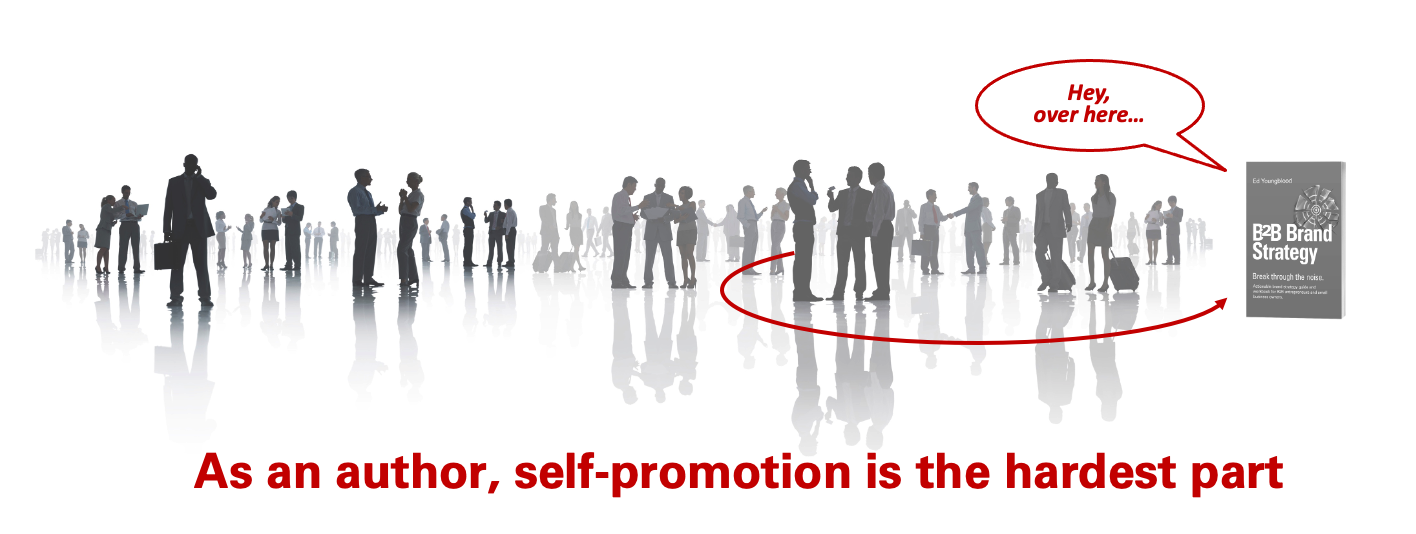
I don’t mean writing a book, though I knew that would be challenging.
Promoting it. I knew self-promotion would be the most challenging aspect. But the reasons might surprise some people.
“I would not have expected that,” a friend and former colleague told me when I confided in her. “You’re in marketing, you of all people should find promoting your book easier than someone who knows nothing of how it works.” She’s not wrong.
I do know how to do it. That’s the irony. I’ve been a marketing professional for over three decades. I know marketing.
To be fair, not all marketing is the same. Tactics and variables can vary widely from one market and buyer to another. Marketing a book is quite different than marketing corporate healthcare. However, the fundamentals remain, and I understand them well. The book itself is testimony. That’s not the problem.
It’s not that I don’t know what to do. It’s that doing it – promoting myself – is something I’ve always been self-conscious about. I come from the show-don’t-tell philosophy. It’s always better when someone else does the telling.
It’s a challenge that has haunted me throughout my professional life as both an owner and consultant.
I discounted the promotion early in the book’s development as I did not expect to do much marketing. I didn’t write it expecting a best seller and steady royalties. It’s a business book, a niche one at that. The goal of writing a book was for market authority and as a positioning anchor. It was conceived as a marketing resource and inbound signal.
Promoting the book makes me feel like I’m on a soapbox extolling my virtues to anyone in range of my social media shouts. In fact, there have been very few posts. The limited promotion I have done is via LinkedIn messages to friends and professional connections. But my LinkedIn connections are not representative of my target audience. It did, however, give me a reason to reach out and reconnect. Somehow, the existing relationship makes it a bit easier to share the news.
I need to get over it if I’m to improve my awareness outreach, but it somehow makes me feel cheap and dirty, so I resist, procrastinate, and overthink it.
The real irony is that it has become more stressful. I’ve wasted time dreading the tactic and dragging my feet rather than focusing and getting it done. It’s all the baggage with none of the rewards.
I know I need to get over it. Maybe that’s what led to this story? Maybe?
Ed Youngblood is a B2B brand and marketing strategist. His book, B2B Brand Strategy, provides frameworks and tools for building strategic brands without an agency (and was the inspiration for this commentary). It is available on Amazon and other leading sellers as e-book and paperback to fit your reading preference.
I’m quite judgmental of marketing content. Well, all content, to be honest, I’m judgmental of all content. I want content to communicate and serve a purpose, and I judge all content I encounter with a critical eye.
I’ve been involved with persuasive content my entire professional life. Heart and soul, I’m a practicing B2B marketing and content strategist that has watched the need for more human-centered, intelligent, content design explode. As B2B buyers become more digital, content becomes ever-more important to buyers and sellers. I saw this trend early and became focused on content and message strategy because of it.
But many of the clients I work with in sales know me only as their presentation secret weapon.
The truth is, I’m no PPT savant. I am a daily power-user, but competency is expected, and no one cares about my technical chops. What they care about is winning the deal, and winning and losing is determined by how well you communicate business value.
It’s a bit ironic, because I’ve never promoted myself as a PowerPoint expert, in fact, I avoided it. It’s not that I don’t enjoy creating presentations, I do, but it was not a B2B niche I expected to serve when I began consulting. I also did not want to be pigeonholed and commoditized.
It found me anyways. It’s surprising in some ways, and not so surprising in others. After all, a PPT presentation is content, and content is one of the things I do best.
Backstory
PowerPoint didn’t even exist when I entered the workforce. As a designer in the commercial production industry, I enjoyed the work and learned a lot about simplifying messages into 0:30 second commercials. I also had a deep interest in being involved in the strategy and creative developed by the agencies. I not only had my own opinions on the creative, but I wanted to understand the bigger ideas driving the strategies.
My first exposure to Microsoft was circa 1990 on early Macintosh desktops in a small design and marketing agency in which I was a partner. At the time, business software and hardware were emerging markets and start-ups were everywhere, fueling our own growth. I was now helping shape and execute brand and marketing strategies. It was also my entry into B2B technology.
Fast forward a few years, and much to my surprise, I’m managing marketing teams in a global technology enterprise. By now, PowerPoint has become a ubiquitous tool. Unfortunately, too many presentations were hopelessly boring energy bludgeons. Corporate life quickly taught me the meaning of “death by PowerPoint” and I swore then I would never inflict such suffering upon anyone subjected to a slide deck I was associated with.
During my years in corporate marketing, I wore many hats, from content to strategy. I also became the go-to guy for executive keynotes. I was good at them, not only from a design perspective, but also because of my instinct for persistent audience focus complimented my ability to simplify complex messages and create continuity. Keynotes were an omen, I just didn’t recognize it at the time.
Hurricane Maria’s lasting impact
I left the corporate marketing world for consulting in 2017 and creating keynote presentations and sales decks was not my target market. Then Hurricane Maria came barging through Houston one Friday night and turned it into a lake. The following Monday morning, an unexpected phone call modified my trajectory.
John Heimann, who at the time, was director of commercial marketing at Anthem of California, was calling. John and I worked together at Alcatel many years prior. He started the call by saying “I don’t know if you can help me, but I’m in a jam.”
He explained that he received a call from the account manager at the Houston agency he was working with and was told “our studio is underwater. Literally, underwater.” They were not going to be able to meet several deliverables because of the hurricane and flooding.
On that Monday, the most critical deliverable to Anthem was an RFP finalist presentation required for a key account within the next 10 days. The ask was a PowerPoint presentation of approximately 60 slides, and the content had yet to be created. Though I felt a bit rusty as a designer, I knew we could make it work.
Anthem won the account and I’ve been working with healthcare sales leaders to pitch key accounts consistently ever since. It’s a role I never saw coming.
While I also help these same organizations define and produce various strategic programs and content, those contributions are invisible to most. For many salespeople I work with, the finalist decks for key accounts are the only work they know me for, so they just see me as the PowerPoint guy. Commoditized by assumption.
But, while many just see a slick presentation, I see an engaging, clear, and relevant message designed for the only people that matter – the decision makers in the room. This is what it takes to keep an audience engaged. This is how I help sales win. This is why I have become their presentation secret weapon, even though I’ve never promoted myself as a PowerPoint expert.
It happened because I met a need, and that need is to help salespeople be successful, especially in front of an audience. And, while many salespeople just see a slick communication tool, I see a lot more. Strong messaging and positioning are a byproduct of understanding what your audience cares about. As with all content, when coupled with well-choreographed creative design and delivery, a good presentation helps presenters be more persuasive.
Most importantly, my experience helps me, help them, win key accounts. And because I help them win, I’ve become a top gun for key account pitch decks and executive keynotes.
I guess I have become a PowerPoint savant. Bring it on.