

We’re Not Listening

Many B2B marketing and sales teams are on autopilot. I offer this series as observations and a belief that we can do better.

Many B2B marketing and sales teams are operating on autopilot.

That may sound harsh but consider the evidence. We have more access to customer feedback, market research, buyer behavior data, surveys, analytics, and industry insights than at any point in business history. Buyers constantly tell us what they want, what they value, what frustrates them, and how they make decisions.

Yet many organizations continue operating as if little has changed.

That disconnect is the topic of this series.

The Listening Gap

At its core, We’re Not Listening is a series of articles about the gap between what markets and customers are telling us, and how B2B organizations respond.

The problem is rarely a lack of information. Most companies already know that buyers are overwhelmed, skeptical, short on time, and increasingly resistant to marketing friction. They know trust is harder to earn. They know buying decisions involve more stakeholders, more scrutiny, and more risk than they once did.

The evidence is not hidden. The challenge has adaptation.

Knowing something has changed is not the same as changing because of it.

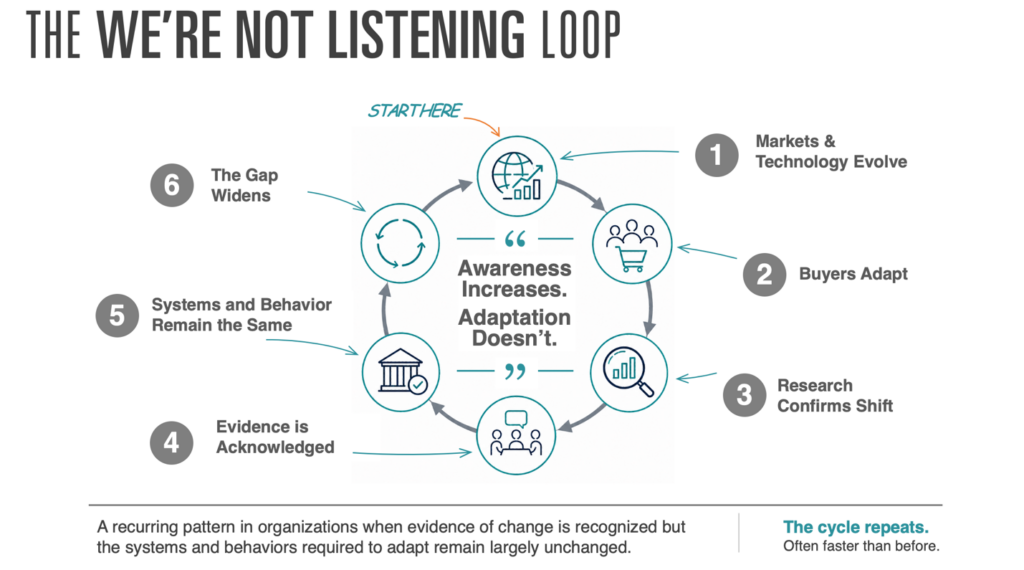
Over the years, I’ve noticed a pattern that appears across industries, business models, and company sizes. I call it the We’re Not Listening Loop:

  1. Markets & technology evolve.
  2. Buyers adapt.
  3. Research confirms the shift.
  4. Organizations acknowledge the evidence and invest in technology.
  5. Business go-to-market systems remain largely unchanged.

The cycle repeats.

New technologies emerge. New channels appear. New buyer expectations develop. Companies discuss the implications, attend conferences, publish reports, and commission research. Then many return to familiar habits, metrics, and assumptions.

The result is activity without meaningful adaptation.
Why It Happens

This is not a criticism of marketers, sales teams, or business leaders.

Most people are doing exactly what they were taught to do. They operate within systems, incentives, processes, and performance measures that were often designed for a different era.

Organizations frequently respond to disruption by adding new tools to old assumptions.

Digital transformation provided countless examples. Companies invested heavily in technology but often struggled to rethink the processes and behaviors surrounding it. Today, artificial intelligence presents many of the same challenges. The conversation quickly gravitates toward tools and tactics while deeper questions about strategy, relevance, trust, and buyer behavior receive less attention.

Technology changes quickly. Organizations often do not.

A Simple Example

Consider gated content.

For years, surveys have consistently shown that many B2B buyers dislike exchanging personal information for generic content. They want useful information. They are far less enthusiastic about the forms, emails, and sales sequences that often follow.

Yet gated content remains a standard practice across much of B2B marketing.

Why?

Because the system often rewards lead volume over buyer experience.

Whether one agrees with gating or not is almost beside the point. What interests me is the pattern. Buyers express a preference. Research validates it. Organizations acknowledge it. Behavior changes slowly, if at all.

The loop repeats.

What This Series Explores

This series examines the habits, assumptions, and blind spots that prevent organizations from becoming as buyer-centric as they claim to be.

Some articles will focus on brand strategy and positioning. Others will explore content, demand generation, sales enablement, buyer behavior, trust, differentiation, customer experience, digital transformation, and artificial intelligence.

The common thread is simple:

The common thread is simple: Objective clarity and opportunities to build prospect trust and confidence, and to improve marketing ROI.

If buyers do not understand what you do, who it is for, why it matters, how it is different, and why they should believe you, more activity rarely solves the issue. In many cases, it simply amplifies confusion.

This is especially true for organizations selling complex products, services, expertise, and solutions.

Marketing is not simply about creating attention. It is about creating understanding.

Sales is not simply about pursuing leads.

It is about helping buyers make sense of a decision.

Brand is not simply about looking polished.

It is about creating shared meaning that helps buyers, sellers, and internal teams move in the same direction.

When those things become disconnected, organizations drift into autopilot. The costs are real: wasted resources, weakened trust, frustrated sales teams, and confused buyers.

Why Follow Along?

The purpose of this series is not to argue that everything old is wrong or everything new is right.

Neither is true.

The goal is to challenge assumptions, ask better questions, and explore how organizations can become more responsive to the realities of modern buying.

For more than three decades, I’ve worked across startups, global enterprises, and independent consulting engagements. I’ve watched business evolve from the analog world of print, broadcast, and trade shows through digital transformation and now into the early stages of the AI era.

Technology continues its rapid evolution. Human behavior does not change so quickly.

Strategy sits in the space between them.

Michael Porter once observed, “The essence of strategy is choosing what not to do.” This series is, at least in part, an exploration of that idea.

Because sometimes the biggest business problem isn’t that we don’t know. It’s that we don’t adapt.

To customers, prospects and stakeholders – we’re not listening.


Thank you for reading, your thoughts and commentary are welcome. And I would be honored if you were to share it with someone that might find it relevant to their own business challenges.

This article was originally published on Medium and republished here.

New Marketing Landscape, Same Old Marketing Conversation?

We cannot solve our problems with the same thinking that we used when we created them.” – Albert Einstein


If you’re involved in marketing, it’s no secret that change is everywhere. Technology has had a profound impact on all aspects of human behavior personally and professionally. The media we consume, how we consume it, and how we interact with brands – not to mention each other – has changed. The emergence of digital has altered everything, and marketing’s role today is not the marcom of yesterday. It’s a new game, with new rules, and an overwhelming number of new media, channels, and tools.

If you’re currently in a marketing leadership role and you find change scary and uncomfortable, now would be a good time to consider a career change. Conversely, if your personality is one that thrives on uncertainty, exploration, and opportunity, know this: Success will be elusive, but you will probably enjoy the ride. This is the reality of marketing today.

The need for transformation

There is endless analysis and conversation today about business transformation and innovation. It is a dominant theme among analysts, technology media, and executive management. Marketing is no exception.

Many of today’s B2B marketing conversations are data-rich, wrapped around annual surveys of marketers and buyers summarizing sentiment, budgets, and priorities. When done well, they capture the preferences and pain points of a profession in transition and have legitimate benchmark value. They clearly document changing trends and challenges, and the best of them deliver true insight. Yet at the same time it feels like something is missing.

The trend of “more” – content, measurement, and beyond

“More” is a recurring theme in recent years for marketing. More media choices, channels, and formats are complemented by the need for more leads and measurement. And, of course, more content. Seventy percent of marketers surveyed in 2015 by Content Marketing Institute (CMI) plan to create more content, but only 8% of B2B marketers rate their content efforts as “very effective.” That’s not a great return on investment. Given the continued challenge over measurement and attribution, one has to wonder about the 8%. Is it tightly measured? Or is it based on circumstantial evidence, or worse, is it assumptive?

This is one of the troubling trends that CMOs are being pressured to correct. Only 5% of marketers surveyed by CMI rate their organization’s efforts to track ROI as “very successful,” and a 2016 DemandWave survey says a full 35% of marketers don’t even have an attribution model, let alone one that is working well.

Content Science reports a couple of equally disturbing success metrics that seem to have survived the analog age of marcom – 27% gauge success by the creation rate of content, and 71% gauge success by “meeting deadlines.” Though no one will dispute the need to hit delivery dates, these metrics do not reflect the performance of content. In fact, they suggest a highly quantitative checklist approach at a time when quality and scalability matter more than ever.

This is all part of the ongoing conversations marketing is having among themselves. But as relevant as these conversations are, they are beginning to feel a bit like redundant noise. That may sound harsh, but most are rich in describing how digital customers have changed buying behaviors, the urgency of digital transformation, and the latest assessment of marketing tactics. Yet, when considered in aggregate, something is missing.

Changing the conversation inside and outside of marketing

Are the conversations around content, marketing, and advertising too narrow? Are they focused on the right things?

This recent Advertising Age article titled “The Big Agenda” is encouraging. It highlights the need to replace short-term thinking for the longer view and reflects a focus on “making marketing work better.” From readers surveyed, these are the top three priority issues in 2016:

1. Making marketing more efficient (55%)
2. Improving creative excellence (54%)
3. Finding new ways to reach consumers as they block or skip ads (52%)

What is missing from the conversation today is the important new role marketing must unequivocally accept – marketing is now a direct and substantial part of the sales process. The new role is not about creating more content and publishing more often; it is about being more effective at earning audience attention and driving demand.

The 2015 B2B Marketing Trends Report from CMI highlights a key organizational challenge that must be part of the new marketing conversation. It is the wide distribution of accountability across organizations for content marketing: C-level (23%), product marketing (19%), demand gen (18%), PR (15%), social media (6%), or the omnipresent “other” (14%).

CMI_Report-content-accountability


The distribution metric is significant because it documents a fractured model aligned to traditional internal structures.

Unfortunately, most attempts to adapt and improve marketing performance have been tactically iterative, constrained by legacy assumptions and habits. Technology, consumers, and communications have changed too much for incremental evolution.
Everyone needs to turn off autopilot and re-think the entire approach, right down to organizational structures and processes. Process is key to efficiency, but a process based on an old set of rules is industrialized disaster. For many, this is the status of B2B marketing today.

Until organizations accept this, marketing execution will be marginalized by the lack of a holistic vision and execution strategy. New, operationally sustainable strategies will need to break old habits, processes, and role-based silos. Digital business requires transformation at every level, perhaps most of all in marketing.

As Einstein said, “We cannot solve our problems with the same thinking that we used when we created them.” Are you ready to change the conversation of marketing?


This article was originally written for and published by Content Science Review.